8 Best LED Red Light Therapy Bulbs (November 2026)
The best best red light therapy led bulbs include the Hooga Red Light Therapy Bulb for targeted home use, the Zarbaha Red Light Therapy Bulb 660nm Red for focused high output, and the Wivety 625nm Red Light Bulb for Sleep for sleep and nursery light.
On this page (18 sections)
- Best best red light therapy led bulbs at a glance
- Best red light therapy LED bulbs: top picks compared
- Hooga Red Light Therapy Bulb: best for targeted home use
- Zarbaha Red Light Therapy Bulb 660nm Red: best for focused high output
- Wivety 625nm Red Light Bulb for Sleep: best for sleep and nursery light
- Wivety LED Red Light Bulbs for Sleep: best for smaller lamps and night feeds
- Lifepro Infraglow Red Light Therapy Bulb: best for clip-on positioning
- Angyues 630nm Red Sleep Bulb Dimmable: best for dimmer-switch control
- ABI LED Light Bulb for Red Light: best for measured irradiance
- PDGROW Red Light Therapy Lamp: best for a narrow treatment beam
- Best red light therapy LED bulbs: side-by-side comparison
- How we compared these red light therapy bulbs
- What wavelength do you actually need?
- Which socket and beam angle fit your room?
- Therapy bulb or sleep bulb: which should you buy?
- How do you set up and use a bulb safely?
- What are the trade-offs between these bulbs?
- Our verdict: which red light therapy LED bulb should you pick?
The best red light therapy LED bulbs for targeted use pair 660nm red light with 850nm near infrared, and the Hooga HG24 and Zarbaha 54W are the strongest matches for that job in this group. The best red light therapy led bulbs for sleep are different, since those use 625nm or 630nm red light, block blue and green light, and dim to a soft glow.
We compared socket fit, wavelengths, beam angle, power and coverage across all eight picks. Our score weighs specs, features and buyer feedback against what you are shopping for, and we checked the specs rather than testing the bulbs.
Red light therapy bulbs, red light therapy bulb, red light therapy bulbs and red light bulb therapy searches often mix two needs. One need is a therapy session aimed at skin, muscles or joints.
The other need is evening light that stays dim and red so the room feels calm for sleep.
This guide keeps those needs apart. Therapy picks run at high output and sit close to the body.
Sleep picks run at low output, dim smoothly, and light a whole room at a gentle level.
If you want broad coverage for a whole body routine, red light panels cover far more skin than a single bulb. If you want a bulb for a sauna, red light therapy bulbs for sauna explains heat and fixture limits.
If you want a narrower wavelength focus, best red light therapy bulbs 660nm narrows the field to 660nm models.
Our picks at a glance
-
1

-
2
 Best for focused high output
Zarbaha Red Light Therapy Bulb 660nm Red
9.6/10 our score
See it on Amazon -
3
 Best for sleep and nursery light
Wivety 625nm Red Light Bulb for Sleep
9.5/10 our score
See it on Amazon
- 4
 Check it
Wivety LED Red Light Bulbs for Sleep
Best for smaller lamps and night feeds - 5
 Check it
Lifepro Infraglow Red Light Therapy Bulb
Best for clip-on positioning - 6
 Check it
Angyues 630nm Red Sleep Bulb Dimmable
Best for dimmer-switch control - 7
 Check it
ABI LED Light Bulb for Red Light
Best for measured irradiance - 8
 Best for a narrow treatment beamCheck it
Best best red light therapy led bulbs at a glance
Hooga Red Light Therapy Bulb: Best for targeted home use
- 660nm red and 850nm near infrared
- 12 dual-chip LEDs
- 24W LED bulb with socket base and braided power cord
- Fits standard E26/E27 socket
- About 85 mW/cm2 at 6 inches
A compact dual-wavelength bulb with a socket base and cord, made for directing light at one area at a time.
Pros
- Both wavelengths in each of 12 LEDs
- Base, cord, plug and switch included
- Under 2 pounds and easy to move
Cons
- Targeted coverage, not whole-body coverage
- 24W output is lower than the 54W picks
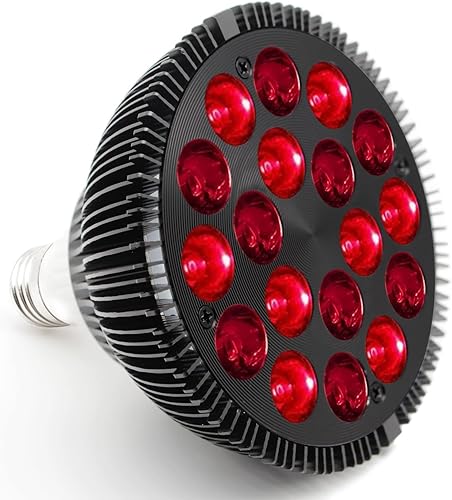
Zarbaha Red Light Therapy Bulb 660nm Red: Best for focused high output
- 660nm red and 850nm near infrared
- 18 LEDs, 54W
- 30-degree optical lens
- E26/E27 base
- Aluminum body with cooling fans
A higher-power, narrow-beam bulb for face, skin, muscle and joint areas, used at close range.
Pros
- 54W output with 30-degree lens
- Aluminum body and 50,000+ hour life
- Fits E26/E27 sockets
Cons
- Narrow beam covers a smaller area
- Socket is not included
Wivety 625nm Red Light Bulb for Sleep: Best for sleep and nursery light
- 625nm red light with blue and green blocked
- 9W E26 A19 bulbs, 4 packs
- Remote dimming to 0.1%
- Flicker-free at every brightness
- Sleep and reading modes
A dimmable red sleep bulb in a 4-pack, made for bedrooms and nurseries rather than targeted therapy.
Pros
- Remote dimming and sleep modes
- Four bulbs for several rooms
- 800 lumens maximum output
Cons
- Not for targeted 660nm therapy
- Not compatible with dimmer switches
Wivety LED Red Light Bulbs for Sleep: Best for smaller lamps and night feeds
- 625nm red light, blue and green blocked
- 5W E26 A15 bulbs, 4 packs
- Remote dimming to 0.1%
- Flicker-free design
- Sleep and reading modes
A smaller A15 version of the Wivety sleep bulb, suited to bedside lamps and nursery lamps.
Pros
- Smaller A15 shape for small fixtures
- Remote control and timer features
- 500 lumens maximum output
Cons
- Lower output than the A19 version
- Not compatible with dimmer switches
Lifepro Infraglow Red Light Therapy Bulb: Best for clip-on positioning
- 18 LEDs with 660nm and 850nm
- 60-degree beam angle
- Clip-on lamp with adjustable direction
- Aluminum housing
- Corded electric power
A clip-on dual-wavelength lamp for aiming light at joints, muscles and skin while you sit or recline.
Pros
- Clip-on and adjustable direction
- 60-degree beam covers more area
- Aluminum housing
Cons
- Low luminous flux of 55 to 65 lm
- 850nm LEDs look dim or unlit
Angyues 630nm Red Sleep Bulb Dimmable: Best for dimmer-switch control
- 630nm red light, blue and green blocked
- 5W E26 A15 bulb, 4 pack
- Smooth dimming from 0% to 100%
- Compatible with most LED dimmers
- 130 lumens maximum output
A budget dimmable red sleep bulb that works with a wall dimmer instead of a remote.
Pros
- Wall dimmer compatible
- Four bulbs in one pack
- No flicker or glare when dimmed
Cons
- 630nm is not the 660nm therapy wavelength
- Low 130 lumen maximum output
ABI LED Light Bulb for Red Light: Best for measured irradiance
- 660nm deep red and 850nm near infrared
- 18 LEDs, 54W class, 27W power draw
- 60-degree beam angle
- 89.3 mW/cm2 at 6 inches
- Internal cooling fan
A 660nm and 850nm combo bulb with stated irradiance at 6 and 12 inches for comparing intensity.
Pros
- Published irradiance at two distances
- 60-degree beam for broader coverage
- 50,000+ hour service life
Cons
- 27W draw despite 54W class name
- Only half the chips appear lit
PDGROW Red Light Therapy Lamp: Best for a narrow treatment beam
- 48W, 24 LEDs
- 660nm red and 850nm near infrared
- 25-degree LED lens
- Aluminum housing
- Fits E26/E27 socket
A 48W dual-wavelength bulb with a tight 25-degree beam for concentrating light on a small target area.
Pros
- Tight 25-degree beam
- 24 LEDs in one bulb
- Aluminum housing with heat sink
Cons
- Narrow beam needs more repositioning
- Near infrared LEDs are invisible
Best red light therapy LED bulbs: top picks compared
The top picks split into two groups. Five bulbs target skin, muscles and joints with 660nm and 850nm.
Three bulbs light a room for sleep with 625nm or 630nm red light.
Choose by that split first. Then choose by beam angle, power and socket fit.
A narrow beam suits one area. A wide beam suits a larger area but spreads the same light thinner.
Hooga Red Light Therapy Bulb: best for targeted home use
The Hooga HG24 is the best fit if you want one compact bulb that does both wavelengths at every LED position. Each of its 12 dual-chip LEDs emits 660nm red and 850nm near infrared, so coverage stays even across the bulb face.
Hooga says irradiance is about 120 mW/cm2 at the surface and about 85 mW/cm2 at 6 inches. That is a strong stated output for a 24W bulb, and it helps explain the 9.7 score.
The set includes a socket base, braided power cord, plug and power switch. You can also screw the bulb into a standard E26 or E27 socket, which gives you two ways to position it.
It weighs under 2 pounds, so it moves easily between a chair, a bedside table and a workout area. That portability matters for a routine you plan to repeat several times a week.
The trade-off is coverage. A single bulb still targets one area at a time, and its 24W output sits below the 48W to 54W picks.
Pick it for targeted use and portability. Pick a wider or higher-power bulb if you want faster coverage of larger areas.
Zarbaha Red Light Therapy Bulb 660nm Red: best for focused high output
The Zarbaha is the best fit if you want high output aimed at a small area. It runs at 54W with 18 LEDs and a 30-degree optical lens, which concentrates light rather than spreading it widely.
Zarbaha says the lens improves irradiance up to 242 mW/cm2. Treat that as a maker-stated peak at close range, and compare it with the ABI figures at fixed distances.
Nine LEDs are 660nm red and nine are 850nm near infrared. Only the red half appears lit, since near infrared is invisible to the naked eye.
The aluminum body, silent cooling fans and 50,000+ hour lifespan suit repeat sessions. It fits a standard E26 or E27 socket and runs on 100 to 240V AC.
Zarbaha suggests use from 3 to 6 inches for 5 to 25 minutes per area, once or twice a day or 4 to 6 times a week. That close range suits face, skin, neck, shoulder and joint areas.
The trade-off is a tight beam. A 30-degree cone covers a smaller patch, so larger areas need more repositioning.
Pick it for focused sessions. Pick a 60-degree bulb if you want broader coverage with less moving.
Wivety 625nm Red Light Bulb for Sleep: best for sleep and nursery light
The Wivety A19 four-pack is the best fit if your goal is evening light, not a therapy session. It emits pure 625nm red light and blocks 100% of blue and green light, which keeps the room dim and darkroom-like.
It runs at 9W with up to 800 lumens, so it can light a bedroom or nursery as a regular bulb would. That output is far above a therapy bulb used at close range, because the job here is room light.
A remote dims the bulb from 0.1% to full intensity with flicker-free light at every level. Six sleep modes dim the light gradually over a set time, and a reading mode gives a brighter setting on one press.
The bulb is not compatible with dimmer switches. Use the remote only, or a wall dimmer may cause flickering or stop the bulb from turning on.
The four-pack shape suits multi-room use. Put one in a bedroom, one in a nursery and keep spares for bedside lamps.
Pick it for sleep, baby care and night feeds. Do not pick it for 660nm targeted therapy, since it does not emit that wavelength.
Wivety LED Red Light Bulbs for Sleep: best for smaller lamps and night feeds
The Wivety A15 four-pack suits the same sleep job in a smaller bulb shape. Like the A19 version, it emits 625nm red light with blue and green light fully blocked, so it supports a calm sleep routine.
It runs at 5W with up to 500 lumens, which is softer than the 9W A19 model. That lower output suits small bedside lamps, nursery lamps and reading lamps where a bright room bulb would be too much.
Remote dimming runs from 0.1% to full intensity, and the light stays flicker-free across that range. Six sleep modes, a reading mode and a timer give you the same control set as the larger bulb.
It uses an E26 base in an A15 shape. Measure your shade and fixture first, since an A15 bulb is shorter and narrower than an A19 bulb even though the screw base is the same.
The same dimmer rule applies. This bulb works with the remote only and not with a dimmer switch.
Pick the A15 for small lamps and gentle night light. Pick the A19 if one bulb needs to light a whole room.
Lifepro Infraglow Red Light Therapy Bulb: best for clip-on positioning
The Lifepro InfraGlow suits buyers who want to aim light without holding it. It is a clip-on lamp with 18 LEDs, adjustable direction and a 60-degree beam angle, so you can clamp it to a stable surface and point it at your body.
Nine LEDs emit 660nm red light and nine emit 850nm near infrared. Lifepro describes the 660nm light for skin and tissue use and the 850nm light for deeper tissue areas, with both wavelengths in one lamp.
The 60-degree beam covers a wider area than the Zarbaha or PDGROW. That helps for legs, shoulders and larger muscle groups, where a narrow cone would need constant repositioning.
The aluminum housing carries CE, FDA and RoHS certification on its spec sheet. It weighs 14.1 ounces and measures about 4.75 inches across, so it fits a compact setup.
The trade-off is light output for room use. Its luminous flux is only 55 to 65 lm, which confirms it is a therapy lamp, not a room bulb.
The 850nm LEDs may also look dim or unlit, and that is normal.
Pick it for hands-free positioning at a chair or bed. Pick a plain screw-in bulb if you already have a lamp or socket you like.
Angyues 630nm Red Sleep Bulb Dimmable: best for dimmer-switch control
The Angyues four-pack is the best fit if you want red sleep light controlled from the wall. It emits 630nm red light with blue and green light blocked, and it dims smoothly from 0% to 100%.
Unlike the Wivety bulbs, it is compatible with most LED dimmers. That makes it the simpler choice for a room that already has a dimmer switch wired in.
It runs at 5W with up to 130 lumens, which is a low, cozy output. That level suits a bedside lamp, a nursing light or low ambient light rather than bright room lighting.
The A15 shape and E26 base fit most lamps. Angyues positions it for bedrooms, nurseries and evening reading, where a soft red glow reduces eye strain at night.
The trade-off is wavelength and brightness. At 630nm, it is a sleep bulb, not a 660nm therapy bulb.
At 130 lumens, it will not light a large room on its own.
Pick it for wall-dimmer control and a low budget per bulb. Pick a Wivety if you want remote control, sleep modes and higher maximum brightness.
ABI LED Light Bulb for Red Light: best for measured irradiance
The ABI bulb suits buyers who want numbers they can compare across models. It pairs nine 660nm deep red LEDs with nine 850nm near infrared LEDs in a 54W class bulb.
ABI states irradiance of 89.3 mW/cm2 at 6 inches and 46.0 mW/cm2 at 12 inches. That drop with distance shows why siting matters, and it gives you a fixed yardstick for judging other bulbs.
The beam angle is 60 degrees, wider than the Zarbaha and PDGROW. A wider beam covers more area per session, though it spreads intensity across that area.
It draws 27W despite the 54W class name, with 18 LEDs rated at 3W each. An internal cooling fan supports the stated 50,000+ hour service life, and ABI offers a 3-year warranty.
ABI also states energy of 26.8 joules per cm2 in 5 minutes at 6 inches. Use that figure to plan session time, while remembering skin comfort matters more than hitting a number.
The trade-off is physical size and look. Only half the chips appear lit, and the bulb is a dedicated therapy device, not a general room bulb.
Pick it for measured output and broad coverage.
PDGROW Red Light Therapy Lamp: best for a narrow treatment beam
The PDGROW suits buyers who want light concentrated on one small target. It runs at 48W with 24 LEDs, split between 660nm red and 850nm near infrared, in an aluminum housing.
Its 25-degree LED lens is the tightest beam in this group. That cone heats and lights a small patch more evenly per unit area, which suits a single joint, a small skin area or a focused muscle group.
It fits a standard E26 or E27 socket and runs on 100 to 240V AC. The built-in heat sink helps with heat dissipation during longer sessions, and PDGROW states a 50,000-hour lifespan.
PDGROW suggests sessions of 10 to 15 minutes, repeated over more than a week for a routine. Near infrared LEDs stay invisible, so half the lamp will look unlit while it runs.
The trade-off is coverage speed. A 25-degree beam needs more repositioning than a 60-degree beam to cover the same area.
Pick it for a tight, focused cone. Pick the ABI or Lifepro for broader coverage in less time.
Best red light therapy LED bulbs: side-by-side comparison
These best red light therapy LED bulbs split cleanly by job. Therapy bulbs pair 660nm with 850nm.
Sleep bulbs use 625nm or 630nm and block blue and green light.
| Product | Best for | Wavelengths | Socket | Power | Our score |
|---|---|---|---|---|---|
| Hooga Red Light Therapy Bulb | targeted home use | 660nm and 850nm | E26/E27 | 24W | 9.7 |
| Zarbaha Red Light Therapy Bulb 660nm Red | focused high output | 660nm and 850nm | E26 | 54W | 9.6 |
| Wivety 625nm Red Light Bulb for Sleep | sleep and nursery light | E26 A19 | 9W | 9.5 | |
| Wivety LED Red Light Bulbs for Sleep | smaller lamps and night feeds | E26 A15 | 5W | 9.3 | |
| Lifepro Infraglow Red Light Therapy Bulb | clip-on positioning | 660nm and 850nm | 9.1 | ||
| Angyues 630nm Red Sleep Bulb Dimmable | dimmer-switch control | E26 A15 | 5W | 8.6 | |
| ABI LED Light Bulb for Red Light | measured irradiance | 660nm and 850nm | E26 A19 | 27W draw | 8.3 |
| PDGROW Red Light Therapy Lamp | a narrow treatment beam | 660nm and 850nm | E26/E27 | 48W | 8.1 |
For therapy, the Hooga leads on dual-chip design and portability. The Zarbaha leads on stated peak output and focus.
The ABI leads on published irradiance at fixed distances. The Lifepro leads on clip-on aiming.
The PDGROW leads on beam focus.
For sleep, the Wivety A19 leads on room brightness and remote modes. The Wivety A15 leads on small-lamp fit.
The Angyues leads on wall dimmer control.
How we compared these red light therapy bulbs
We compared specs, features and buyer feedback against what each searcher wants. Therapy buyers want wavelength pairings, intensity at a stated distance, beam angle and socket fit.
Sleep buyers want blue light blocking, dimming range, flicker-free light and room brightness.
We checked wavelength first. A 660nm and 850nm pairing suits targeted therapy.
A 625nm or 630nm bulb with blue light blocked suits sleep and nursery use. Mixing those jobs in one bulb rarely works well.
We checked socket fit second. Most picks use an E26 base, and several also fit E27.
The Lifepro uses its own clip-on housing. A bulb that does not fit your fixture will not help, no matter how strong its output is.
We checked beam angle and stated irradiance third. Narrow beams concentrate light.
Wide beams cover more area. Fixed-distance irradiance figures, like the ABI figures at 6 and 12 inches, help you judge real intensity.
Health note: red light therapy bulbs are general wellness devices. They are not meant to diagnose, treat, cure or prevent disease.
If you have ongoing pain, skin concerns or sleep problems, talk with a doctor before starting a routine.
What wavelength do you actually need?
For targeted therapy, choose 660nm red light with 850nm near infrared. That pairing appears on five picks here, and it is the standard pairing for skin, muscle and joint routines.
The 660nm light is visible and red. The 850nm light is near infrared and invisible to the naked eye.
That is why half the chips look dark on combo bulbs, even when the bulb is working.
For sleep light, choose 625nm or 630nm red with blue and green blocked. Those bulbs are not therapy bulbs.
They are room bulbs that keep evening light dim, red and calm.
If you want a closer look at 660nm models alone, best red light therapy bulbs 660nm narrows the search. If you want a warmer incandescent style instead, red light therapy incandescent bulb explains that different technology.
Which socket and beam angle fit your room?
Check your socket before you buy. E26 is the standard US base on most picks here.
The Hooga, Zarbaha and PDGROW also fit E27 sockets used in some fixtures.
Check your bulb shape too. The Wivety A19 and ABI A19 are full-size room bulbs.
The Wivety A15 and Angyues A15 are shorter bulbs for small lamps and shades.
Beam angle decides coverage speed. A 25-degree beam like the PDGROW concentrates light on a small patch.
A 30-degree beam like the Zarbaha is similar, with higher stated output.
A 60-degree beam like the Lifepro and ABI covers a wider area. That suits legs, back and shoulders, where you want fewer repositioning steps per session.
If your fixture is in a sauna, heat changes the choice. Read red light therapy bulbs for sauna before using any bulb where heat builds up.
Therapy bulb or sleep bulb: which should you buy?
Buy a therapy bulb if you will sit close to it for timed sessions. Those bulbs run at high output, aim at one area, and pair 660nm with 850nm.
Buy a sleep bulb if you want room light in the evening. Those bulbs dim to a soft red glow, block blue and green light, and run for hours without timed sessions.
Buy a sleep bulb for a bedroom, nursery, night feeds or late-night reading. Buy a therapy bulb for face, skin, muscle recovery and joint routines at home.
If you want a therapy bulb in a tanning bed frame, red light therapy bulbs for tanning bed covers that different setup. If you want a stand for aiming a bulb, best red light therapy lamp with stand lists stands that hold lamps at sitting height.
How do you set up and use a bulb safely?
Screw the bulb in firmly without overtightening. For the Lifepro, tighten the socket screws and clamp the housing to a stable surface before use.
Keep the bulb at the distance your routine calls for. The Zarbaha guide uses 3 to 6 inches, and the ABI figures show intensity at 6 and 12 inches.
Closer means stronger intensity and smaller coverage.
Do not stare directly at the lamp. Zarbaha and Lifepro both warn against looking at the LEDs directly during use.
Give your eyes a break between areas. Move the bulb to each new area in turn, and stop if you feel uncomfortable during a session.
If you want a lamp for a desk instead of a bulb, best red light therapy desk lamp covers desk-sized options. For a general lamp shortlist, best red light therapy lamp compares lamp forms beyond screw-in bulbs.
What are the trade-offs between these bulbs?
Therapy bulbs trade coverage for intensity. The Zarbaha at 54W and 30 degrees concentrates light, while the Hooga at 24W trades peak power for portability and a cord with a switch.
Wide beams trade intensity for speed. The Lifepro and ABI at 60 degrees cover more area, but the same light spreads thinner than a 25-degree PDGROW cone.
Sleep bulbs trade therapy wavelength for room comfort. The Wivety and Angyues bulbs block blue light and dim smoothly, but they do not emit 660nm or 850nm.
Control also trades off. The Wivety bulbs need a remote and will not work on a dimmer switch.
The Angyues works on most dimmers but has no remote, no sleep modes and only 130 lumens at full brightness.
Price per bulb also matters in packs. A four-pack of sleep bulbs spreads cost across rooms.
A single therapy bulb focuses cost on one area you will use daily.
Our verdict: which red light therapy LED bulb should you pick?
Pick the Hooga HG24 for targeted home use, since it combines both wavelengths in every LED and includes a base, cord and switch. Pick the Zarbaha for focused high output at close range on small areas.
Pick the ABI for measured irradiance and broad 60-degree coverage. Pick the Lifepro for clip-on aiming at a chair or bed.
Pick the PDGROW for the tightest beam on one small target.
Pick the Wivety A19 for sleep and nursery room light. Pick the Wivety A15 for small lamps.
Pick the Angyues for wall dimmer control at low brightness.
The best red light therapy LED bulbs for you depend on the job, not the highest score alone. Therapy first, sleep second, socket fit always.
That order will keep you from buying a bright therapy bulb for a nursery, or a dim sleep bulb for a joint routine.
Our top 3 picks at a glance
-
1
-
2
Best for focused high output
Zarbaha Red Light Therapy Bulb 660nm Red
9.6/10 our score
See it on Amazon -
3
Best for sleep and nursery light
Wivety 625nm Red Light Bulb for Sleep
9.5/10 our score
See it on Amazon
Frequently asked questions
What wavelength should a red light therapy bulb have?
For targeted therapy, look for 660nm red light paired with 850nm near infrared. That pairing appears on the Hooga, Zarbaha, Lifepro, ABI and PDGROW picks here.
For sleep lighting, 625nm or 630nm red bulbs block blue and green light and dim to a soft glow.
Do all these bulbs fit a standard light socket?
Most picks fit a standard E26 socket, and the Hooga, Zarbaha and PDGROW also fit E27. The Lifepro uses its clip-on lamp housing rather than a plain household socket.
Check your fixture shape and socket size before you order, especially for enclosed fixtures.
Why do only half the LEDs look lit?
The 850nm near infrared LEDs are invisible to the naked eye. On dual-wavelength bulbs, only the 660nm red LEDs appear illuminated.
That is normal operation on the Zarbaha, ABI, PDGROW and Lifepro models.
Can I use a dimmer switch with these bulbs?
Only the Angyues 630nm sleep bulb is designed for most LED dimmer switches. The Wivety sleep bulbs use remote dimming and are not compatible with dimmer switches.
Therapy bulbs here are meant to run at full output for treatment sessions.
How close should I sit to a therapy bulb?
The Zarbaha guidance is 3 to 6 inches from the body for 5 to 25 minutes per area. The ABI publishes irradiance at 6 and 12 inches, so you can compare intensity at those distances.
Distance changes coverage and intensity, so move the bulb to cover each area in turn.


