9 Best Salt Test Strips for Hot Tubs (November 2026)
The best salt test strips for hot tub include the HotSpring Spas Salt Water Test Strips for ACE spa systems, the SaySummer Salt-Water Pool Test Strips Kit for all-in-one salt testing, and the Joyzakzak 8-Way Pool Test Strips -150 CT for high-count value.
On this page (9 sections)
- How to compare salt test strips for a hot tub
- The best salt test strips for hot tubs, ranked by fit
- What range should salt test strips for hot tub use show?
- Do you need salt water hot tub test strips or balance strips?
- How often should you test, and how do you read the chart?
- Can hot tub test strips with salt replace liquid tests?
- What other gear pairs well with salt testing?
- How do we compare salt water hot tub test strips?
- Which salt test strips should you buy for your hot tub?
The best salt test strips for hot tub use are the HotSpring Spas Salt Water Test Strips, because they are built for spa salt systems and check the core levels a saltwater spa needs. If you want one strip that also checks salt plus seven other levels, the SaySummer 8-in-1 kit is the next best fit.
Salt test strips for hot tub care do one job well. They check dissolved salt so your salt cell can make chlorine at a steady rate.
Our score weighs specs, features and buyer feedback against what you're shopping for. We compared counts, salt ranges, parameters checked and ease of use for hot tub owners.
A saltwater hot tub needs more frequent checks than a large pool. The water volume is small, the heat is high, and skin and oils enter the water with every soak.
In a spa, a small change in salt can change chlorine output within days. Test strips help you catch that shift before the water turns dull or the cell works harder than it should.
Hot tub water also evaporates faster than pool water. That loss can raise salt concentration, while top ups and splashing can lower it, so a steady routine matters more than a single careful test.
Our picks at a glance
-
1

-
2
 Best for all-in-one salt testing
SaySummer Salt-Water Pool Test Strips Kit
9.6/10 our score
See it on Amazon -
3
 Best for high-count value
Joyzakzak 8-Way Pool Test Strips -150 CT
9.5/10 our score
See it on Amazon
- 4
 Check it
Hot Spring Freshwater Spa Test Strips
Best for FreshWater spa balance - 5
 Check it
Poolmaster 4-Way Swimming Pool & Spa Test
Best for quick weekly checks - 6
 Check it
AquaChek Salt Test Strip Titrators for Pools
Best for dedicated salt readings - 7
 Check it
FreshWater Hot Spring Spas Portable 5 Way
Best for portable spa checks - 8
 Check it
FUNSWTM 2026 New Pool Test Strips
Best for copper and salt checks - 9
 Check it
Joygain 8-in-1 Pool Salt Test Strips
Best for salt system range checks
How to compare salt test strips for a hot tub
The best salt test strips for hot tub use cover salt first, then the balance levels that protect the spa. Salt alone does not tell the full story.
Check the salt range first. Look for a chart that highlights about 2700 to 3400 ppm, the common ideal range for salt systems.
Then check what else the strip measures. pH, total alkalinity, free chlorine and bromine affect comfort and equipment.
Count matters for routine care. A hot tub owner who tests twice a week will use about 100 strips in a year.
Compare a saltwater vs chlorine hot tub if you are still deciding on a system. Salt systems still make chlorine, so you still test chlorine levels.
Salt level tells you whether the cell has enough feedstock. Chlorine level tells you whether that feedstock is turning into sanitizer at the rate you need.
pH and alkalinity shape how chlorine works and how the water feels. Hardness helps you watch for scale on warm surfaces, which can build faster in a hot tub than in a cool pool.
Cyanuric acid matters most in outdoor water. It can lower chlorine strength in sunlight, so an 8 in 1 strip that includes it gives a fuller picture for uncovered spas.
How the chart shapes your decision
A chart that marks the ideal band in a clear color helps you decide in seconds. You can see at a glance whether salt needs salt added, water diluted, or no change at all.
A wide chart, such as 0 to 6000 ppm, helps after a drain and refill. A narrower chart, such as 1500 to 5000 ppm, still covers normal operation and can make normal readings easier to compare.
Hold the strip level and read it in daylight. Shaking off excess water, waiting the full time, and matching colors under the same light each time all improve consistency.
The best salt test strips for hot tubs, ranked by fit
These picks are ordered by score for hot tub use. Dedicated salt strips rank high for accuracy on salt, while multi-parameter strips rank high for daily balance checks.
HotSpring Spas Salt Water Test Strips: Best for ACE spa systems
- 5 lb container
- For ACE Spa System
- Tests active and total cleaner, pH, alkalinity and hardness
Built for HotSpring ACE spa use, with a large container for long-term spa owners.
Pros
- Made for spa salt testing
- Large container supply
- Covers core spa balance levels
Cons
- Large container may be more than casual users need
- Less suited to pools than spa use
HotSpring Spas Salt Water Test Strips suit owners with an ACE spa system who want a spa specific option. Watkins Wellness makes this 5 lb container, model WAT76234, for cleaning and testing hot tub or spa water.
The strips check active and total cleaner, pH, total alkalinity and hardness. Those levels help protect spa surfaces from damage linked to pH swings and scale build up.
Hot tubs need more care than pools because heat speeds chemical reactions. HotSpring guidance suggests testing before and after each use and tracking results each time.
The large container suits frequent testers who keep a steady routine. Casual owners may prefer a smaller count, since a 5 lb container is a long term supply.
Trade off matters here. This pick is strong for spa salt systems, but it does not offer the broad 8 in 1 pool style chart that some owners prefer for one dip testing.
It also suits owners who want fewer pads to read. A focused set can be easier for quick pre soak checks than a strip with eight colors.
SaySummer Salt-Water Pool Test Strips Kit: Best for all-in-one salt testing
- 125 count
- 8-in-1 testing
- Salt range 0-6000 ppm
- Highlights 2700-3400 ppm
One dip checks salt plus total hardness, free chlorine, bromine, total chlorine, cyanuric acid, total alkalinity and pH.
Pros
- Checks salt and 7 other levels
- 125 strips for regular testing
- Clear 2700-3400 ppm guide on chart
Cons
- Color matching needs good light
- Large count suits frequent testers most
SaySummer Salt-Water Pool Test Strips Kit suits owners who want salt and balance levels in one dip. The kit holds 125 strips and measures 8 parameters.
One strip checks salt plus total hardness, free chlorine, bromine, total chlorine, cyanuric acid, total alkalinity and pH. That covers the daily levels most saltwater hot tub owners track.
The salt pad measures from 0 to 6000 ppm. The chart highlights the common ideal range of 2700 to 3400 ppm, which helps you see at a glance if salt is in range.
Use is simple. SaySummer says to dip for 2 seconds, hold horizontally for 30 seconds, then compare to the chart on the bottle.
Trade off is reading care. An 8 pad strip needs good light and a calm minute.
Even so, 125 strips make this a practical choice for twice weekly testing.
For larger spas and pools, the same routine works across water types. That flexibility helps if you maintain more than one body of water.
Joyzakzak 8-Way Pool Test Strips -150 CT: Best for high-count value
- 150 count
- 8-way testing
- Salt range 1500-5000 ppm
- Includes step-by-step instructions
A 150-strip 8-in-1 kit that measures salt from 1500 to 5000 ppm and highlights the typical ideal range.
Pros
- 150 strips for a full season
- Single-dip 8-parameter check
- Chart highlights recommended salt range
Cons
- Salt range starts at 1500 ppm
- Busy chart needs a careful read
Joyzakzak 8-Way Pool Test Strips suit owners who test often and want a large count. The set holds 150 strips for hot tub and spa use.
Each strip measures salt, pH, free chlorine, total chlorine, bromine, total alkalinity, hardness and cyanuric acid. That single dip routine covers salt output plus balance in a few minutes.
Salt measurement runs from 1500 to 5000 ppm. The chart highlights the typical ideal range of 2700 to 3400 ppm and notes 2500 to 3500 ppm as normal.
Joyzakzak says the fiber paper helps prevent color bleed between pads. Clear separation helps when you compare 8 colors at once.
Trade off is the lower end of the salt range. If your system needs readings below 1500 ppm, a wider range strip may fit better.
Step by step instructions are included in the set. That helps new owners follow the same dip, hold and compare routine each time.
Hot Spring Freshwater Spa Test Strips: Best for FreshWater spa balance
- Tests bromine, chlorine, alkalinity, pH and hardness
- Swirl 3 times method
- Chart on bottle
Portable spa strips for total bromine, free chlorine, alkalinity, pH and total hardness.
Pros
- Focused on spa balance levels
- Simple swirl and compare method
- Portable for spa use
Cons
- Does not list a dedicated salt pad
- Best paired with a salt-specific strip
Hot Spring Freshwater Spa Test Strips suit FreshWater spa owners focused on daily balance. Hot Spring Spas makes these portable strips, model 73687, for spa water.
Each strip checks total bromine, free chlorine, alkalinity, pH and total hardness. Those five levels tell you if the water is clear, odor free and balanced for soaking.
The method is to immerse the strip, swirl 3 times, remove with pads face up, and compare against the chart on the bottle. That routine is quick enough for before use checks.
This pick does not list a dedicated salt pad. Pair it with a salt specific strip if your cell output is your main concern.
Trade off is scope. For a saltwater hot tub, you still need a salt reading.
For pH and sanitizer balance, this spa focused set is simple and direct.
The portable format fits a spa side routine. Owners who test before guests arrive can get a quick read without setting up a larger kit.
Poolmaster 4-Way Swimming Pool & Spa Test: Best for quick weekly checks
- 100 count total
- Tests chlorine, bromine, alkalinity and pH
- Made in the USA
A simple 4-way strip for free chlorine, bromine, pH and total alkalinity in pools, spas and hot tubs.
Pros
- Fast dip and compare routine
- 100 strips for weekly checks
- Clear pads resist color bleed
Cons
- No salt pad
- Use with a separate salt test
Poolmaster 4-Way Swimming Pool & Spa Test suits owners who want fast weekly checks. The pack holds 100 strips in total.
Each strip measures free chlorine, bromine, pH and total alkalinity. Those are the four levels Poolmaster positions for routine pool, spa and hot tub care.
No bleed pads help keep colors separate for a clearer read. The routine is dip, remove, and compare to the color chart.
Made in the USA, this set is built for quick checks before swimming or soaking. It helps avoid dosing mistakes when you adjust sanitizer or alkalinity.
Trade off is clear. There is no salt pad here.
Use this for balance checks and a dedicated salt strip for cell output.
The 100 count supports weekly testing for a full season. That makes it a useful second kit alongside a salt specific option.
AquaChek Salt Test Strip Titrators for Pools: Best for dedicated salt readings
- 10 strips
- Salt range 400-7000 ppm
- White titrator strips
- Includes water chemistry insert
Dedicated salt titrator strips that measure sodium chloride from 400 to 7000 ppm without drop counting.
Pros
- Wide 400-7000 ppm salt range
- No reagent drops to count
- Focused on salt generator output
Cons
- Only 10 strips
- Does not check pH or chlorine
AquaChek Salt Test Strip Titrators suit owners who want a dedicated salt reading. The pack holds 10 white titrator strips.
Each strip measures sodium chloride from 400 to 7000 ppm. That wide range covers low salt after a refill and high salt after over-adjustment.
AquaChek says the strips use medical industry technology and avoid counting drops of reagent. That design leaves less room for error than liquid drop kits.
The kit includes a water chemistry insert and directions. AquaChek suggests testing water at least twice a week for safe, balanced water.
Trade off is count and scope. Ten strips will not last long for twice weekly testing, and the strips check salt only.
Buy extra balance strips for pH and chlorine.
The wide range is useful when salt is far from target. It helps you judge how much salt to add or how much dilution may be needed.
FreshWater Hot Spring Spas Portable 5 Way: Best for portable spa checks
- 5 way testing
- Checks dichlor, pH, total alkalinity and hardness
- For spa and hot tub
Portable 5-way strips for hot tubs that check dichlor, pH, total alkalinity and hardness.
Pros
- Portable spa format
- Covers daily balance levels
- Built for hot tub use
Cons
- No dedicated salt measurement
- Count is not stated in title data
Hot Spring Spas Portable 5 Way Test Strips suit owners who want a portable hot tub option. FreshWater by Watkins Wellness makes this set for spa and hot tub use.
The strips check dichlor, pH, total alkalinity and hardness. Those levels help you track sanitizer and balance between soaks.
Portable strips fit a spa side routine. You can test before a soak and adjust before guests arrive, without a full test station.
This pick does not list a dedicated salt measurement. It works best as a balance companion to a salt strip.
Trade off is detail. The title data does not state a count, so check the pack details before you buy for a full season.
For owners who already track salt with a dedicated titrator, this format covers the remaining daily levels. It keeps the routine short and focused on comfort.
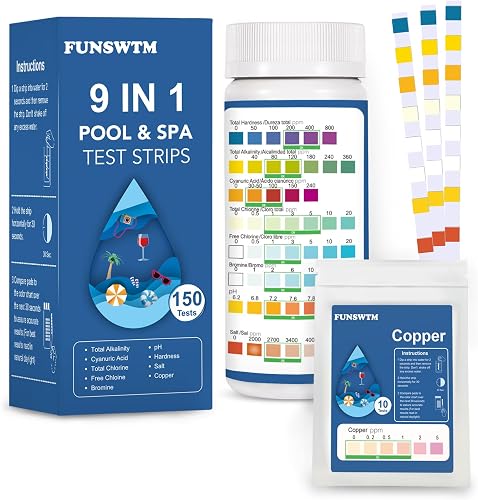
FUNSWTM 2026 New Pool Test Strips: Best for copper and salt checks
- 150 count in title
- 9-in-1 testing
- Salt range 0-6000 ppm
- Includes copper strips
A 9-in-1 kit that adds copper testing to salt, pH, chlorine, bromine, alkalinity, hardness and cyanuric acid.
Pros
- Adds copper to the usual levels
- Wide 0-6000 ppm salt range
- 150 count for regular use
Cons
- More parameters can complicate reading
- Use within 90 days after opening for best accuracy
FUNSWTM 2026 New Pool Test Strips suit owners who also want copper readings. The title lists 150 counts for salt water pool testing.
Each main strip tests 9 parameters. Salt level from 0 to 6000 ppm is checked with pH, total chlorine, free chlorine, bromine, alkalinity, hardness, cyanuric acid and copper.
The kit splits counts between main strips and copper strips. FUNSWTM says copper is tested on separate strips for extra precision.
Use is a simple dip and color compare. The brand gives a shelf life of 2 years from manufacture and suggests use within 90 days after opening.
Trade off is complexity. Nine pads need a careful read, and copper is not a level every hot tub owner tracks weekly.
Choose it if copper checks matter to you.
The wide salt range helps after refills or large adjustments. Owners who maintain saltwater pools and spas can use the same kit across both.
Joygain 8-in-1 Pool Salt Test Strips: Best for salt system range checks
- 150 count
- 8-in-1 testing
- Salt focus 2700-3400 ppm
- Includes color chart
An 8-in-1 strip set that checks salt plus pH, free chlorine, total chlorine, bromine, alkalinity, hardness and cyanuric acid.
Pros
- 150 strips for year-round testing
- Focuses on 2700-3400 ppm salt range
- One dip for 8 levels
Cons
- Chart reading needs care
- Best for established salt systems
Joygain 8-in-1 Pool Salt Test Strips suit owners focused on the ideal salt range. The pack holds 150 strips for pool and spa use.
Each strip checks salt, pH, free chlorine, total chlorine, bromine, total alkalinity, total hardness and cyanuric acid in one dip.
Joygain focuses salt measurement on the 2700 to 3400 ppm range. That focus helps salt chlorine generators and saltwater hot tubs stay in the target zone.
The routine is dip for 2 seconds, wait 30 seconds, then match colors to the chart. No tools or extra chemicals are needed.
Trade off is chart care. With 8 pads, good light helps.
For regular weekly testing, 150 strips provide a full season supply.
The set includes a color matching chart for comparison. That chart helps you keep the same routine at the spa side each week.
What range should salt test strips for hot tub use show?
The best salt test strips for hot tub use should clearly show the 2700 to 3400 ppm range. That range is the common ideal for salt systems.
SaySummer highlights that range on a 0 to 6000 ppm chart. Joyzakzak highlights it on a 1500 to 5000 ppm chart.
AquaChek covers a wider 400 to 7000 ppm range. That width helps when salt is far off target after a refill or drain.
FUNSWTM also covers 0 to 6000 ppm. That range helps you see both low salt after a refill and high salt after evaporation.
Joygain focuses its salt measurement on 2700 to 3400 ppm. That focus suits owners who run a stable system and mainly need to confirm they remain in range.
What if salt is below range?
Low salt can reduce chlorine output from the cell. Add salt in small steps and retest after the pump has run.
Do not add a large amount at once. Small steps help you avoid overshooting, which can require dilution to correct.
What if salt is above range?
High salt does not make water unsafe by itself, but the cell may need adjustment. Partial draining and refilling can lower salt, if needed.
Check your cell maker guide before you drain. Some systems tolerate a wider band than the typical ideal range.
Do you need salt water hot tub test strips or balance strips?
You need both types for full care. Salt strips check cell feedstock, while balance strips check pH, sanitizer and alkalinity.
A hot tub with a salt system still produces chlorine. You must test free chlorine just as you would with a chlorine system.
Salt tells you about input. Chlorine tells you about output.
You need both to know if the cell is doing its job.
pH tells you about comfort and equipment protection. Alkalinity helps keep pH steady, so a low or high reading can explain why pH keeps moving.
Hardness helps you watch scale formation. Warm spa water can deposit scale faster, especially on heaters and small jets.
When one strip does both jobs
8-in-1 strips check salt plus balance levels in one dip. That saves time for twice-weekly routines.
One dip also means one chart comparison. That can be faster, but it puts more weight on reading several pads under the same light.
When separate strips work better
Dedicated salt titrators, like AquaChek, focus on salt accuracy. Pair them with 4-way or 5-way balance strips.
Separate strips let you test salt less often than balance levels. You can check pH and sanitizer before each soak and salt weekly.
How often should you test, and how do you read the chart?
Test at least twice a week, plus before and after heavy use. HotSpring Spa guidance suggests testing before and after each use for spa water.
Dip for the time stated on the bottle, usually a few seconds. Then hold the strip level and compare colors in daylight.
Do not shake the strip. Excess water can change color development, and shaking can spread color between pads.
Read the chart at the stated time. Waiting too long can deepen some colors and make a normal reading look high.
How do you track results?
Keep a simple log with date, salt, pH, sanitizer and alkalinity. Trends help more than one reading.
Note heavy use, top ups, and salt additions in the same log. Those events explain many sudden shifts in a small spa.
A weekly log also helps you see whether a cell cleaning changes chlorine output. Salt may stay in range while output still falls.
Look at best saltwater hot tub chemicals after you test. Test first, dose second, then retest.
Retesting after a dose confirms whether the change worked. It also stops you from adding more product on top of a level that was already moving.
Can hot tub test strips with salt replace liquid tests?
Strips are best for routine checks. Liquid titration can give finer readings for salt when you make big adjustments.
AquaChek positions its titrators as comparable to liquid tests in accuracy. That claim is about salt strips versus drop counting, not about all strips.
For most owners, strips give enough detail for weekly decisions. If salt sits near the edge of the ideal band, a finer test can help you decide.
Strips also suit quick pre soak checks. You can confirm pH and sanitizer in minutes without setting up liquid reagents.
Which should you buy first?
Start with a multi-parameter strip for weekly use. Add a dedicated salt titrator if cell output seems off.
That order covers daily balance first. Salt specific strips then help you check whether input or output is the problem.
What other gear pairs well with salt testing?
Good test strips work best with a simple routine and a clean, dry storage spot. Keep the bottle closed and away from wet hands.
Moisture can damage unused strips. Store the container in a dry place and close the cap right after you take a strip.
The best saltwater hot tub accessories guide covers gear that supports weekly care. A log book and a small towel by the spa help you test before each soak.
A towel helps you dry your hands before you handle the bottle. That small step can protect the remaining strips from spa water.
If you drain or refill often, check the best pump to drain hot tub guide. Refills change salt levels, so test again after the water stabilizes.
Test after the pump has run and the water has mixed. A reading taken right after a refill may not reflect the final salt level.
Owners with inflatable spas should also read the best Coleman SaluSpa accessories guide. Small spas can shift chemistry fast after a refill.
Small water volume means each soak adds more oils and skin products per gallon. That makes frequent testing more important than in a large pool.
How do we compare salt water hot tub test strips?
We checked specs for count, salt range, parameters and intended use. We weighted salt range and spa fit most for this search.
We looked at how each strip reads: one dip, swirl method, or titrator style. We also checked if the chart highlights the ideal salt range.
We did not test these strips. Scores reflect specs, features and buyer feedback for hot tub use.
We gave more weight to kits that check salt plus balance levels. For hot tub owners, that single dip routine can support twice weekly testing without extra tools.
We also weighted count for routine care. A 125 or 150 count kit can last a full season for most owners, while a 10 count pack suits occasional salt checks.
Dedicated salt strips received credit for wide ranges and focused accuracy. Balance only strips received credit for simple spa routines, with a note that they still need a salt test.
Which salt test strips should you buy for your hot tub?
Pick the HotSpring Spas Salt Water Test Strips if you run an ACE spa system and want a spa-specific supply. Pick SaySummer if you want salt plus 7 balance levels in one dip.
Pick Joyzakzak if you test often and want 150 strips. Pick AquaChek if you want a dedicated salt reading from 400 to 7000 ppm.
Pick Poolmaster or Hot Spring Freshwater if you mainly need balance checks and will add a salt strip. Pick FUNSWTM if copper testing matters to your routine.
Pick Joygain if you want a salt focused 8 in 1 kit for a stable salt system. Its 150 count suits year round weekly testing.
For the full system picture, read Sauna vs Hot Tub: Dry Heat or Warm Water? before you buy a new spa. Then use these strips to keep salt, pH and chlorine in range week after week.
Our top 3 picks at a glance
-
1
-
2
Best for all-in-one salt testing
SaySummer Salt-Water Pool Test Strips Kit
9.6/10 our score
See it on Amazon -
3
Best for high-count value
Joyzakzak 8-Way Pool Test Strips -150 CT
9.5/10 our score
See it on Amazon
Frequently asked questions
What salt level should a saltwater hot tub be?
Most saltwater systems aim for about 2700 to 3400 ppm of salt. That range helps the cell make chlorine without excess salt in the water.
Check your cell maker guide for the exact target for your model.
How often should you test a saltwater hot tub?
Test at least twice a week, and before and after heavy use. Hot tubs are small and warm, so chemistry can shift fast.
Keep a simple log so you can spot trends instead of guessing.
Do salt test strips replace liquid tests?
Strips are fine for routine checks and quick decisions. Liquid titration can give finer readings when you are adjusting salt or fixing a balance problem.
Many owners use strips weekly and liquid tests for monthly checks.
Can you use pool salt strips in a hot tub?
Yes, many strips are made for pools, spas and hot tubs. The salt range and chart matter more than the word pool on the label.
Check that the chart highlights the 2700 to 3400 ppm range.
Why does salt level matter if the cell makes chlorine?
The cell uses dissolved salt to make chlorine. Low salt can reduce chlorine output, while high salt can leave excess salt in the water.
Testing salt helps you keep output steady between cell cleanings.


