Ceramic vs Carbon Infrared Sauna Heaters: Which Is Better? (November 2026)
Choose ceramic heaters for focused, direct warmth and carbon heaters for broader, more even coverage. Your sauna size, heater layout, warm-up preference and replacement plans should guide the choice.
On this page (11 sections)
- Ceramic vs carbon infrared sauna heaters: what is the main difference?
- How does heat distribution compare?
- Which heater warms up faster?
- Which heater gives the most even warmth?
- Does ceramic or carbon use less electricity?
- Which design is easier to replace?
- Are ceramic heaters safer than carbon heaters?
- What should you choose for a 1-person sauna?
- What should you choose for a 2-person sauna?
- How do ceramic and carbon heaters fit into a full infrared sauna plan?
- Ceramic vs carbon infrared sauna heaters: final choice
Choose ceramic infrared sauna heaters for focused tube heat and carbon heaters for broader panel coverage. The right pick depends on where you sit, how you use the sauna and what care you are willing to do over time.
Ceramic elements are usually tube shaped, so their heat tends to feel more direct. That can suit a smaller room where each tube can be placed close to the person using it.
Carbon elements are often built into wider panels, so their heat tends to spread across more surface. That can suit a larger seating area where even coverage matters more than a strong focal point.
Neither layout is better in every home, and the heater map matters as much as the material. Tube count, panel size, spacing and distance from the bench all change how warmth feels in daily use.
Heat spread is one practical difference to weigh before you choose. Focused tubes can create clear warm zones, while broad panels can reduce the contrast between hot and cool sections.
Warm-up is another difference, but it cannot be judged from the material alone. Wattage, room volume, insulation and heater placement all affect how quickly the space feels ready.
Power use also depends on the complete sauna rather than the label on the heater. A lower wattage system may draw less power, while a higher wattage system may warm a larger room more quickly.
Maintenance is worth considering early, not after a replacement is needed. You should know the heater type, power rating and model details so a matching part can be identified later.
Set-up matters too for both designs. Clearances, controls, wiring and guard placement should follow the sauna instructions exactly, and any unclear electrical work should be checked by a qualified professional.
This guide compares ceramic vs carbon infrared sauna heaters by placement, heat spread, warm-up, power and maintenance. It also looks at nearby products that show how different infrared systems are used outside a sauna cabinet.
Use the comparison to match the heater to your room size, seating position and session routine. The best layout is the one that warms the areas you use while fitting your space and electrical plan.
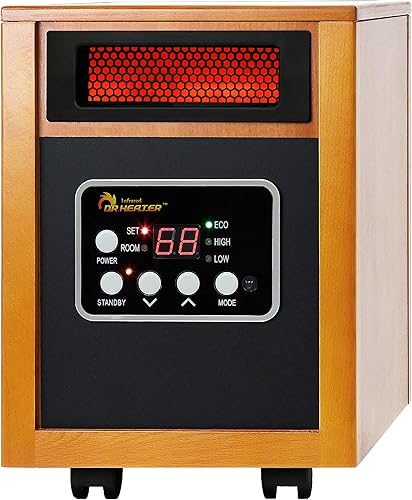 Best for room heating
DR. INFRARED HEATER Dr Infrared Heater DR-968 Portable
 Best for mounted carbon heat
DR. INFRARED HEATER Portable Infrared Indoor
Ceramic vs carbon infrared sauna heaters: what is the main difference?
Ceramic heaters create more focused heat, while carbon heaters usually cover a wider surface area. That difference affects where warmth is strongest inside the sauna.
A ceramic tube concentrates heating near the element. A sauna with several tubes can place warmth behind the back, beside the body or near the legs, but the exact experience depends on tube count and spacing.
Carbon heaters generally use broad heating surfaces. Their larger area can support more even coverage across a wall or panel, although the result still depends on the number, size and position of the panels.
The material alone doesn't tell you everything. A well-planned ceramic layout can cover the body better than a poorly placed carbon panel, and a carbon design can feel more balanced than a sauna with widely separated tubes.
How does heat distribution compare?
Ceramic heaters suit targeted body zones, while carbon heaters suit wider coverage. Look at the heater map rather than the material label alone.
Ceramic tubes can direct warmth toward specific parts of the body. This is useful when a sauna places elements across the back, sides and feet.
The 2-person KUNSANA uses 6 ceramic infrared heating tubes plus a concealed foot heating panel. Its rear tubes have an independent switch, so the layout gives you more control over one section of the sauna.
Carbon panels spread heat across a larger flat area. That can reduce strong hot spots, but the sauna still needs enough panel surface to warm the space evenly.
The compact KUNSANA takes a mixed approach. It combines ceramic heating cubes with carbon crystal far-infrared heating plates, giving one person both focused and broad heating surfaces.
Which heater warms up faster?
Warm-up speed depends more on wattage, insulation and room size than on ceramic or carbon alone. Compare the full sauna system before treating one heater type as faster.
The 2-person KUNSANA has 1840 watts and a stated 10-minute quick warm-up, not maximum temperature. Its temperature control range is 77–149°F.
The compact 1-person KUNSANA uses 1240 watts and gives an 8–15 minute quick warm-up range, also not maximum temperature. Its control range is 77–140°F.
The smaller sauna has less space to warm, but lower power. The larger sauna has more power and more heater coverage, but it also has more interior volume and a 2-person capacity.
If warm-up matters, compare the sauna's internal dimensions, power, insulation and heater placement together. The phrase “quick warm-up” doesn't mean the sauna reaches its highest setting in that time.
For a broader overview, read our guide to infrared sauna heater types. It explains how ceramic, carbon and other infrared designs differ.
Which heater gives the most even warmth?
Carbon is usually the stronger choice for broad, even coverage, while ceramic can be better for direct warmth at specific positions. Your preferred seat and the heater map matter more than a general material label.
A carbon panel can warm a larger section of the wall at once. This may feel more consistent when you sit several inches away from the surface.
Ceramic tubes can create stronger zones near each element. That can be useful for focused warmth, but spacing matters because a gap between tubes may feel cooler.
The KUNSANA 2-person model places ceramic tubes around the room and adds concealed foot heat. That design addresses a common weakness of tube-only layouts by adding warmth lower in the sauna.
The compact KUNSANA combines ceramic and carbon elements. It may suit someone who wants tube-style warmth without giving up the wider surface area of carbon crystal plates.
Does ceramic or carbon use less electricity?
Power use is determined by the sauna's wattage and operating time, not by the heater material alone. A lower-wattage carbon system can use less electricity than a high-wattage ceramic system, and the reverse can also be true.
The 2-person ceramic KUNSANA is rated at 1840 watts. The compact mixed ceramic and carbon KUNSANA is rated at 1240 watts.
Those figures describe connected power, not your exact daily energy cost. Your session length, warm-up time, temperature setting and local electricity rate all affect use.
The DR-968 provides a useful contrast because it is a portable indoor space heater with a 1500-watt infrared quartz tube plus PTC system. It is not a ceramic or carbon sauna heater, but it shows why “infrared” alone doesn't identify the element type.
Before connecting a sauna, review Infrared Sauna Electrical Requirements to Know. Match the sauna's power needs to a suitable circuit and follow the installation instructions.
Which design is easier to replace?
Choose the heater design with clear model information and accessible replacement parts. A theoretical advantage in heat spread won't help if the correct element is difficult to identify later.
Ceramic tubes may be easier to recognize by shape and position, but replacement still requires the correct length, power rating, wiring and mounting method. Never install a tube only because it looks similar.
Carbon panels can cover more surface area, but a panel replacement must match the sauna's size, wiring and control system. A different panel may change heat output or fail to fit the mounting space.
Keep the sauna model number, heater type and power details after installation. The KUNSANA 2-person model is identified as KM-902SHD-sauna room, while the compact model is KM-901MHD SAUNA.
The DR-238 is a separate carbon infrared heater with 900, 1200 and 1500-watt settings. It is designed for wall or ceiling mounting and includes mounting brackets, but it is not automatically suitable as a replacement for a sauna element.
Are ceramic heaters safer than carbon heaters?
Neither material is automatically safer in every installation. Safe use depends on correct wiring, clearances, controls, ventilation and the sauna's instructions.
Ceramic tubes can become very hot at the element. Keep skin, towels and other objects away from the heater surface, and don't alter the guard or mounting position.
Carbon panels may have a broader surface that feels less sharply focused, but they still produce heat and need suitable clearances. Follow the sauna's operating limits rather than judging safety by touch.
Use the built-in controls as intended. Don't bypass automatic shutoffs or modify wiring to increase heat.
If you use infrared light features alongside sauna heat, review our guide to infrared sauna eye protection. Eye comfort and heat safety are separate concerns.
What should you choose for a 1-person sauna?
Choose a compact mixed ceramic and carbon design when you want one-person size with both heating approaches. A pure ceramic layout makes more sense when focused tube heat is your main priority.
The compact KUNSANA is a 1-person sauna with ceramic heating cubes and carbon crystal heating plates. It uses 1240 watts, has a 77–140°F control range and measures 66.57 x 32.32 x 35.47 inches.
Its combination is useful for shoppers who don't want to choose strictly between ceramic and carbon. The trade-off is that it isn't a pure example of either layout.
A 1-person sauna also limits the amount of interior air to warm. That can make a lower-wattage system practical, but it won't provide space for another user.
What should you choose for a 2-person sauna?
Choose a multi-tube ceramic sauna when you want direct heat zones, foot heating and room for 2 people. Check the room size, delivery path and electrical setup before you commit to the larger cabinet.
The 2-person KUNSANA includes 6 ceramic infrared heating tubes, a concealed foot heating panel and 1840 watts. That layout gives each seated person more nearby warmth than a single small heater could provide.
It also includes red light therapy, reading lights and 2 Bluetooth speakers. Those extras can make a shared session more comfortable, but they do not replace the main heaters or change the sauna temperature range.
Its external size is about 47.09 x 39.21 x 76.06 inches, with product dimensions also shown as 62.99 x 42.91 x 76.37 inches. Measure doorways, turns and the final floor area carefully before ordering.
The control range reaches 149°F, with a stated quick warm-up of 10 minutes that does not mean maximum temperature. Allowing extra time beyond that first warm-up helps the room feel more settled before a session.
The heating tubes cycle near the upper setting, with brief shutoffs and restarts to maintain the range. That cycling is part of normal operation as described, so expect the heat to rise and ease rather than stay flat.
The main trade-off is space and power. Two people benefit from the wider heater layout, but the cabinet needs more floor room and a higher wattage supply than a 1-person sauna.
How do ceramic and carbon heaters fit into a full infrared sauna plan?
Choose the heater type after deciding the sauna size, seating position and electrical setup. The heater should support the room plan rather than determine it by itself.
A 1-person room can favor a compact mixed system. A 2-person room may need more heater surface or more elements to provide useful coverage across both seats.
If you want a separate infrared light source, compare it with the sauna's built-in heating system. Our guide to the best infrared sauna lamp covers a different product category, so don't treat a lamp as a replacement for the sauna's main heaters.
You may also be weighing infrared heat against a traditional sauna. Our Infrared Sauna vs Traditional Sauna: The Gaps comparison explains how room temperature, heat method and session experience differ.
For lower-voltage setups, see How to Choose 110V Infrared Sauna Heaters. Confirm the exact sauna requirements before choosing a circuit or heater.
Ceramic vs carbon infrared sauna heaters: final choice
Pick ceramic when you want focused tube heat, defined heater zones and strong direct warmth. Pick carbon when you want wider panel coverage and a more spread-out heating surface.
Choose the compact KUNSANA if you need a 1-person sauna with both ceramic and carbon heating surfaces. Choose the larger KUNSANA if you want 2-person capacity, 6 ceramic tubes and a concealed foot panel.
For a separate carbon heater, the DR-238 offers mounted installation and 3 power settings, but it should not be treated as a sauna replacement without compatibility confirmation. The DR-968 is a room heater with quartz and PTC elements, useful as a comparison but not a ceramic or carbon sauna system.
The best answer to “infrared sauna ceramic vs carbon heaters” is the layout that matches your body position, room size, power plan and future replacement needs.
Frequently asked questions
Are ceramic or carbon heaters better for an infrared sauna?
Ceramic heaters are better when you want focused warmth from tube-style elements, while carbon heaters are better when broad, lower-glare coverage matters more. The best choice also depends on the sauna's heater layout, power requirements, room size and whether replacement parts are easy to match.
Do ceramic infrared heaters heat faster than carbon heaters?
Ceramic heaters often feel direct because the elements concentrate heat near the tube, but warm-up depends on wattage, enclosure, insulation and heater placement. Carbon heaters can spread heat across larger panels, so compare the complete sauna design instead of choosing by material alone.
Which infrared sauna heater lasts longer?
Neither ceramic nor carbon automatically lasts longer in every sauna. Service life depends on the element, controls, ventilation, cleaning and replacement access.
Choose a sauna with clear heater information and keep the model details available when you need a matching replacement.
Can you replace ceramic heaters with carbon heaters?
Do not assume the swap will work. Ceramic and carbon elements can differ in shape, wiring, power draw, controls and mounting.
Use the exact replacement specified for the sauna, and have a qualified electrician check the installation if the heater or wiring is unclear.