Near vs Far Infrared Sauna: Which Should You Choose? (October 2026)
Choose far infrared for a lower-temperature home sauna room or blanket, and near infrared when you specifically want that wavelength. Near vs far infrared sauna choices depend on heater type, session format and the features you want.
On this page (8 sections)
- Near vs far infrared sauna: what is the difference?
- How do sauna format and heat system affect the choice?
- Which system fits your home and routine?
- What should you check before buying?
- Which products match each buyer?
- What are the main tradeoffs between infrared and traditional saunas?
- Which sauna should you choose?
- Frequently asked questions
Choose far infrared for a lower-temperature home sauna room or blanket, and near infrared when you specifically want that wavelength. The near vs far infrared sauna decision depends on the heater system, the kind of session you want and how much space you can give it.
Near and far infrared describe parts of the infrared spectrum. They don't tell you on their own whether a sauna is a cabin, a blanket or a tent, or how its controls work.
The options below include far infrared cabins and a blanket, plus a steam tent as a format comparison. The tent is not an infrared wavelength option.
 Best for portable far infrared
Lifepro RejuvaWrap Infrared Sauna Blanket with Low
 Best for a compact indoor room
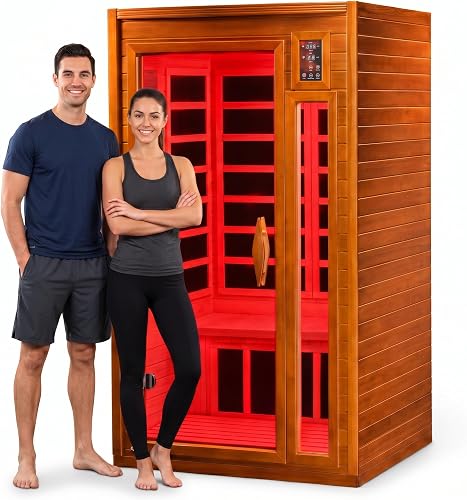
Dynamic Saunas Barcelona 1-2 Person Infrared Sauna
Near vs far infrared sauna: what is the difference?
Near and far infrared refer to different wavelength ranges; the sauna's heater design determines how each product delivers heat. Check the actual heating method instead of relying on a broad label alone.
Far infrared models in this comparison use carbon heating elements. The Lifepro blanket uses carbon fiber heating, while the OUTEXER cabin uses carbon panels.
Near infrared is a separate wavelength choice. If that is your priority, review the heater details in our guide to near infrared saunas for home.
A model that combines multiple wavelengths may be described as full spectrum. See our guide to the best full spectrum infrared sauna options if you want to compare systems built around more than one infrared range.
How do sauna format and heat system affect the choice?
Choose the format you can set up and use comfortably, then confirm its heater type. A cabin, a blanket and a steam tent support different routines, even when they all create warmth.
A cabin gives you a dedicated enclosed space. The Dynamic Saunas Barcelona is designed for 1–2 adults, while the OUTEXER is a wooden far infrared room.
A blanket folds away and doesn't need the same floor area as a cabin. The Lifepro RejuvaWrap is a far infrared blanket with a 5–60 minute timer and 9 heat levels.
A tent can be portable, but check whether it uses infrared or steam. The KASUE tent in this comparison has a 3 L steamer, so it doesn't answer a near-versus-far infrared buying need.
For a plain-language look at the basics, read how an infrared sauna works. If you're comparing infrared with a heated-rock sauna, see infrared sauna vs traditional sauna.
Which system fits your home and routine?
Far infrared suits you if you want one of the carbon-heated options here; choose near infrared if that specific wavelength is your priority. Then decide whether a blanket or a room fits your space and routine.
When should you choose far infrared?
Choose far infrared if you want a carbon-heated blanket or cabin from this selection. The Lifepro is foldable, while the OUTEXER and Dynamic Saunas models are enclosed rooms.
The Lifepro's 9 heat levels range from 95°F to 176°F, and its timer runs from 5 to 60 minutes. Its maker says it warms gradually, with about 5–10 minutes of warm-up and up to 10–15 minutes to reach full operating temperature.
The OUTEXER cabin uses 6 far infrared carbon panels and has a temperature setting range of 68°F–149°F. Its wooden-room design and separate bottom heating plate may appeal if you want a permanent cabin setup.
The best far infrared saunas for home guide can help you compare more far infrared room options.
When should you choose near infrared?
Choose near infrared when the wavelength itself is important to your search. Confirm that the model uses near infrared and review how the maker describes its heater placement and controls.
Don't assume all infrared saunas include near infrared. Some use far infrared elements, while others may combine several ranges under a full-spectrum design.
Near infrared is not a promise of a particular health result. Our overview of infrared sauna benefits and disadvantages covers practical tradeoffs to consider without treating sauna use as medical care.
When might a full-spectrum model make sense?
A full-spectrum model may suit you if you want more than one infrared wavelength in the same sauna. Check which wavelengths the system includes and how you can control its heaters.
The phrase can describe different product designs, so compare exact model details instead of treating it as a guarantee of a specific experience. If you already know you want more than one range, use the full-spectrum sauna guide to narrow your options.
What should you check before buying?
Confirm the heat source, dimensions, controls and electrical needs before choosing a sauna. Those details determine whether the unit fits your room and the way you plan to use it.
For a cabin, measure the installation area and delivery path, including turns and doorways. The Barcelona measures 36 x 32 x 67 inches internally and assembles on an indoor surface with a standard 15-amp, 120-volt plug.
The OUTEXER measures 35.2 x 27.6 x 61.6 inches and weighs 160 lb. Make sure the floor, access route and available space can handle a wooden room of that size.
For a blanket, check its fit, surface care and timer. The Lifepro measures 71 x 36 inches in its coverage description, includes a controller and carry bag, and should be wiped clean rather than machine washed.
Read the manual for setup and use instructions. If you are new to near infrared sessions, our guide on how to use a near infrared sauna can help you think through session planning.
Which products match each buyer?
Choose a product by matching its heating method and format to your needs. The KASUE is included to show a portable steam alternative, not as an infrared wavelength pick.
Our score weighs specs, features and buyer feedback against what you’re shopping for.
What are the main tradeoffs between infrared and traditional saunas?
Infrared cabins use infrared heaters, while traditional saunas heat the room through a different system. The right choice depends on the kind of heat and room setup you want.
The Barcelona operates up to 135°F, with a recommended comfort range of 115°F–130°F. That gives you a clear temperature range to consider, but it doesn't make the sauna interchangeable with every traditional model.
Compare the heater type, temperature range, installation needs and cleaning routine of the exact models. The infrared and traditional sauna comparison lays out those differences.
Which sauna should you choose?
Pick far infrared if you want a carbon-heated cabin or blanket from these options; pick near infrared if you specifically want that wavelength and verify the heater system before buying. Choose a steam tent only if steam is the feature you want.
For a foldable far infrared option, the Lifepro blanket has adjustable heat and a timer. For a cabin, compare the Barcelona's 1–2 person layout with the OUTEXER's wooden far infrared design.
A near vs far infrared sauna should match both your wavelength preference and your space. Start with the far infrared wavelength guide if you want to understand that part of the decision.
Frequently asked questions
Is near infrared better than far infrared?
Neither is better for every buyer. Near and far infrared refer to different wavelength ranges, while a home sauna's room layout, heater design and session format affect everyday use.
Compare the exact system and its intended use, then choose the wavelength that matches your priorities.
Can one sauna use both near and far infrared?
Some products are described as full spectrum and combine near, mid and far infrared, while others use far infrared panels alone. Check the exact heater setup and product details before buying.
A label such as full spectrum doesn't tell you how the sauna performs in your room.
Do near and far infrared saunas heat the room the same way?
Sauna designs vary, so don't assume every near or far infrared model heats the room in the same way. Compare the heater placement, temperature range and cabin layout for the exact model.
Those details can help you decide whether its heat setup and format suit your session preferences.
Is an infrared blanket the same as an infrared sauna?
An infrared blanket surrounds your body in a foldable format, while a cabin gives you an enclosed room to sit in. Both can use infrared heating, but they differ in space, setup and how you use them.
Check the product's heating type and care instructions before choosing.
Is a steam tent a near or far infrared sauna?
A steam tent uses a steam generator to create a warm, humid environment; that alone doesn't make it a near or far infrared sauna. Check the heating method before buying if you want a particular wavelength.
A steam tent can still suit you if a portable steam session is the goal.